The World Bank by Eric Toussaint
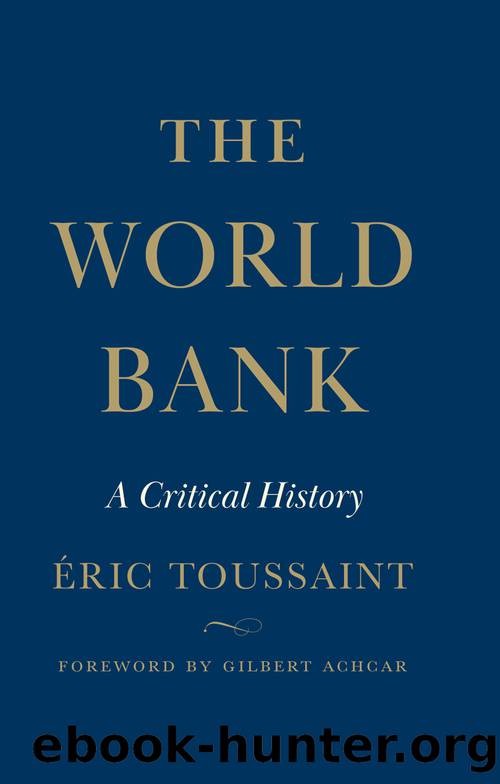
Author:Eric Toussaint
Language: eng
Format: epub
Publisher: Pluto Press
16
Presidents Barber Conable and Lewis Preston (1986â95)
BARBER CONABLEâS TERM OF OFFICE (1986â91)
The Republican congressman Barber Conable succeeded the banker Alden W. Clausen for a term that started in July 1986 and ended in August 1991. James Baker, Secretary of the Treasury, and Ronald Reagan chose Conable because of his thorough knowledge of all the mysteries of the US Congress. At the time, the US Executive had its hands full with its legislative majority since several Republican representatives questioned the weight of the World Bank in US foreign policy (see chapter 5). Barber Conable had 20 yearsâ experience in Congress and had long been the ranking Republican member of the Ways and Means Committee. James Baker and Ronald Reagan wanted Barber Conable to appease the recalcitrant Republicans and persuade them to let the White House steer the World Bank.
The issue was complex and Conable soon found himself in a precarious situation. While he wished to expand the World Bankâs activities, the White House made some concessions to the recalcitrant elements, limited the resources granted to the World Bank and demanded that Conable reduce its expenditures. When he did this a number of senior executives and all of the staff turned against him. In 1987 the internal reorganization of the Bank was a veritable game of musical chairs. Several top managers resigned.1
Conable also met other obstacles. Several of the Bankâs large-scale model projects were challenged by the concerned populations and by environmental associations. The three projects that prompted the most determined protests were the Polonoroeste programme in Brazilian Amazonia,2 the various dams on the River Narmada in India, and the transmigration project and the Kedung Ombo dam in Indonesia.3 The largest demonstration occurred in India, where some 50,000 people from all parts of the country marched in the city of Harsud (Madhya Pradesh) in September 1989. A fourth World Bank programme also raised strong opposition from human rights organizations, namely the Ruzizi II hydroelectric project that concerned Zaire (as the DRC was then called) and Rwanda and involved the displacement of some 2,500 farmers without any significant compensation.4 Barber Conable promised that the World Bank would in the future take environmental impacts into account and would see to it that affected people would receive decent compensation.5 This was truly a titanic task since in India alone the World Bank financed 32 projects involving the displacement of some 600,000 people from 1978 to 1990.6
In 1988 the World Bank and IMF annual meeting in West Berlin was greeted by 80,000 demonstrators who denounced their antisocial policies. This was the first mass demonstration against the Bretton Woods institutions.
The uprisings triggered by the policy of structural adjustment and the consequent deterioration in the âadjustedâ peoplesâ standards of living in the countries concerned led the World Bank to mention the issue of poverty after ten years of silence. The 1990 World Development Report is entirely devoted to it.
It was also with Barber Conable as president that the Bank started to systematically refer to âgood governanceâ. In 1990
Download
This site does not store any files on its server. We only index and link to content provided by other sites. Please contact the content providers to delete copyright contents if any and email us, we'll remove relevant links or contents immediately.
| Anthropology | Archaeology |
| Philosophy | Politics & Government |
| Social Sciences | Sociology |
| Women's Studies |
The Secret History by Donna Tartt(19085)
The Social Justice Warrior Handbook by Lisa De Pasquale(12190)
Thirteen Reasons Why by Jay Asher(8909)
This Is How You Lose Her by Junot Diaz(6885)
Weapons of Math Destruction by Cathy O'Neil(6279)
Zero to One by Peter Thiel(5801)
Beartown by Fredrik Backman(5751)
The Myth of the Strong Leader by Archie Brown(5507)
The Fire Next Time by James Baldwin(5442)
How Democracies Die by Steven Levitsky & Daniel Ziblatt(5218)
Promise Me, Dad by Joe Biden(5153)
Stone's Rules by Roger Stone(5087)
A Higher Loyalty: Truth, Lies, and Leadership by James Comey(4960)
100 Deadly Skills by Clint Emerson(4924)
Rise and Kill First by Ronen Bergman(4788)
Secrecy World by Jake Bernstein(4752)
The David Icke Guide to the Global Conspiracy (and how to end it) by David Icke(4717)
The Farm by Tom Rob Smith(4507)
The Doomsday Machine by Daniel Ellsberg(4490)
